Search This Blog

Wednesday, August 5, 2015

Wilson's Plover

It has been a long time since Sharon and I headed out to Grandview Nature Park. So with shorebird migration picking up, we decided to make a trip out there. There is by far the best place near us for shorebirds and well as other unexpected birds. eBird has nearly 200 species reported from the 3 mile long stretch of beach along the Chesapeake Bay and Back River. The best birding is usually at the far end, known as Factory Point for an old fish processing plant that washed away many decades ago. But there is usually enough going on along the way that we tire out before getting to the end. This time we committed to getting to Factory Point quickly and birding on our way back. We also timed our trip to arrive at low tide to have the best mudflats. We pretty much stayed to plan we only a few diversions to look for seaside sparrows and check out the rocks of the old lighthouse (the only rocky part here). We found ruddy turnstones on the rocks but no sparrows. As we approached the end we found a couple of peep sandpipers (a genus of small and rather similar birds that can be challenging to distinguish) that we eventually identified as semipalmated sandpipers. We then reached the first set of mudflats. There were several sandbars with a range of gulls and terns and many more shorebirds, semipalmated plovers, semipalmated sandpipers, sanderlings, turnstones, least sandpipers, and an american oystercatcher. There was also a killdeer flying over. Just as we had arrived, another birder caught up with us. We chatted for a few minutes and then he headed to the other side of the point where he had seen whimbrels several days previous.

As we finished up with our scan and were preparing to move further down the point, the other birder, Ernie, came rushing back. "I think I have a Wilson's plover, you've got to see it." We packed up and followed him back. A Wilson's plover would be quite a find. They are rare visitors along the part of the western shore of the Chesapeake Bay. He led us to a large expanse of mud and water saying, "it was the only bird out here." We all set up and started scanning but found nothing. Ernie was in a frenzy to get confirmation, even though he has good photos to back-up his identification. We continued scanning and eventually found a semipalmated plover. "No, that's not it It couldn't have left. It was just walking around here and had been here feeding for several minutes." Still we scanned without luck. Finally Ernie saw movement just over a small ridge in the mud. We moved further along the beach were the ridge, probably all of 6 inches, wouldn't block our view. And then we saw it. The plover is masterfully camouflaged and was hard to pick out when it didn't move. But sure enough. There it was.


Ernie was already late for an appointment so he packed up and headed home.We watched for a few more minutes and then started our way back. We had planned to spend time birding on the trip back but it was starting to get late, we were tiring, and there hadn't been much action along the beach. We did get some more nice shorebirds, including a black-bellied plover that was still in breeding plumage.

In the short trees along the dune we found a pair of common yellowthroats and a prairie warbler. We also followed a small group of shorebirds most of the way down beach. As we would approach they would flush further down never realizing we were still coming and would have to get past them at some point. In the end, it was a great day out at a great location that we don't get to enough.


Sunday, August 2, 2015

Our First BioBlitz

On Friday July 31, my wife and I joined the Nansemond River Preservation Alliance's pilot BioBlitz at Bennett's Creek Park in Suffolk, VA. For those not in the know, a BioBlitz is an intense survey of wildlife, usually to make a catalog of animals, plants, insects, etc. living in a region.  This particular event was aimed at starting a field guide to wildlife in Suffolk to promote tourism. NRPA plans several more in the coming years at other parks and locations around town.

Pair of Spotted Sandpipers
Approximately 20 people showed up to participate. This event was also being used as an outreach event so instead of splitting us into teams focused on different biological orders, we were scheduled to spend an hour on birds, plant life, insects, and aquatic life. The bird expert they had scheduled ended up stuck in traffic (not that uncommon in Hampton Roads) so we started off without them. Sharon and I stepped up and helped out the back-up leader. We had done a little background research using eBird and the park had not been actively birded in the past. There were only a few checklists submitted and most had just a handful of birds. And the start of the walk was exceedingly slow. The highlight was a lone Great Egret across the creek. A few heard birds added to the list but not the groups enjoyment. Finally we came out of the the wooded area to a large field and found the birds. In addition to the typical mowed-lawn birds, like mockingbird and grackles, we had a few eastern bluebirds, barn swallows and a great crested flycatcher. We ended the walk at the boat dock were we flushed a spotted sandpiper who flew across the creek, circled around a bit, picked up a buddy, and the both landed on a downed tree on the far side of the creek. The most unexpected bird of the day and pleasantly good views.

Searching for Marsh Grasses
We then turned our attention to plants and trees. We had a professor and doctoral student leading the walk. We started with a really old cypress tree and some of the other plants and trees that surrounded it. The student guide, Peter, walked out into the marsh and collected several plant species to show covering the range of grass, sedge, and rush. This walk brought many more questions than the bird walk; perhaps due to the tie to gardening. We also found a couple of fragrant plants and passed those around. As that hour wound down we received news that the insect leader would not be attending. So the leaders decided to continue on with the botany talk but also the group would try and point out any insects they could identify. This was a little disappointing to Sharon and myself as that was the second most interested walk to us. Sharon did start us off well with spotting this red-spotted purple butterfly. We saw a few other things but most everyone's attention was on the plants. We discovered later that a small group of knowledgeable people had splintered off and identified a few dozen insects. We wish we had known and would have joined them.

Red-spotted Purple Butterfly
The final walk was aquatic life. A couple of people had a sieve net that they put in the water at the boat dock and scooped up some fish, crabs, shrimp, and oyster shells. There was really a pretty limited diversity here. Perhaps due to the warm temperatures in the creek as well as the limited survey area. As the water temperature rises, the oxygen level falls so many fish move to deeper waters to stay cool and have access to more oxygen.

Amongst the participants were three newspaper reports. The organizers must have done an excellent job promoting the event. The large turnout is testament to that as well.  Here are the two articles in the Virginian-Pilot and the Suffolk News-Herald. Something to add to our scrapbooks. There's been talk of the master naturalist chapter that I am part of doing a BioBlitz. If so, I will return to the topic again.


Saturday, March 14, 2015

Frogs, Frogs, Everywhere there's Frogs

Our group. Photo by S. Burton
It's Friday night, cool and rainy. So what to do? Go searching for salamanders, of course. And maybe a frog or two. Twelve of us from the Peninsula Master Naturalists gathered to search for salamanders, frogs, and whatever else the night rains might bring out. We drove to a different part of Grafton Ponds than our last outing where we knew there would be some active ponds much closer to parking. It was twilight as we walked down the abandoned road; a quartet of Wood Ducks flew high overhead calling as they went. We passed one vernal pool where we could hear a lot of spring peepers calling. But they are hard to see and our goal was salamanders so we plunged deeper into the park while keeping in mind that we would pass by here on the way out. We finally reached our target pool and dove into the woods. Daylight was failing and the tree cover was thick so on came our lights. As soon as we arrived at the pool, we found our first southern leopard frog. The first of many, many, many. We placed the frog in a small baggie so we could all get a look at it and it could stay moist. But the frog was a bit peeved and started extruding a toxic substance so we released it back. While humans are not particularly susceptible to this toxin, any other frog placed in that baggie would quickly succumb.
First Southern Leopard Frog of the Night

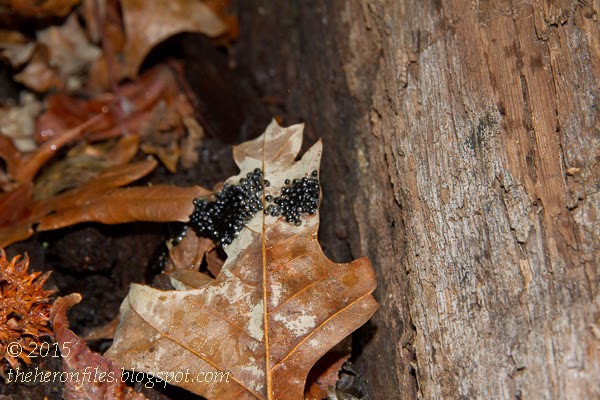
The group was large enough that we often ended up breaking into two or three smaller groups to explore along the pool's edge. One group had moved ahead and found a bunch more frogs calling. As the rest of us moved to catch up, someone spotted this small mass of eggs on a rotting log.

None of us were sure what they were. Most salamanders and frogs would lay their eggs in the near-by pool so they would stay moist. So who would leave them out on a rotting log? Later we discovered the likely source of these eggs. They would be frogs eggs that never made it to the water. (possibly disturbing image next, you are warned)
This frog had succumbed to a predator and showed the same type of eggs as we had seen earlier. A bit of a gruesome find but also fascinating to see the eggs still with the frog. The carcass was drying out so it had been there for a while. We aren't sure what the predator was or why it would leave such a meal behind. Surely the eggs must be a good source of fat and protein. And all of that meat. That will remain a mystery.
Now back to the less gruesome. The lead group had found a small cove [do vernal pools have coves?] that had several dozen calling southern leopard frogs and masses of frogs eggs.With all of the human commotion the frogs had moved away from the edge out of camera range. But as Sharon scanned the water's surface out to 30-50 ft, the surface was dotted with tens of pairs of eyes. And those were only the ones looking in our general direction. It was fascinating to see the eye-shine from the frogs on the dark water.
Southern Leopard From Egg Mass

Same Type of Eggs but Under Different Lighting
Photo aside:  These night-time hikes have been my first real experience with animal photography in the dark and I'm still feeling my way around. Between using other people's headlamps, the on-camera flash, and, tonight for the first time, my wife's LED macro light, the lighting and color is quite variable. I would like to find a time to go out on my own and just experiment to see what works. I've seldom used a flash in the past, preferring natural light. But in the dark, everything looks the same in natural light: black. Many of my photos last time were blurred because I had exposed for the light from headlamps and used flash. So long exposures allowed for camera shake and ghostly second images to appear. Tonight I tried to either use the steady light or flash and not both. It didn't always work out but that is why I took so many photos.

We were successful in finding a handful of salamanders. Most of what we found, and all I saw, were Mabee's again. Mabee's is a state threatened species only occurring in the tidewater region but not too close to the coast. Grafton Ponds is one of its strongholds. An interesting find was the variability in size. This first one was about half the size of the later ones. We would find most, or maybe all, of them under the edge of a rotting log (I wasn't actually there for any of the salamander finds). So like the curious herpetologist we are, we rolled over every good looking log we could find. And then returned the log to their original place if we found nothing. If we did find a salamander, we would get a good look and then return the log and make sure the salamander was right next to it (you don't want to put the log back on top of the salamander and squish it).

Mabee's Salamander

By the time we reached the far side of the pool we were once again separated into two group. Here's the other half on the other side of a finger of the pool. I think that must be Fred with his double-barreled light source at the far right side. He is the only one you could pick out by his headlamp.

 
Along the way I found this cool-looking feather floating in the water and a wonderfully posed frog. The frog showed much more green and distinctive markings than any of the previous ones. It was just sitting on the side of a fallen tree. You can see the rounded, irregular spots on the back, the strong lines along the sides, and a hump in the middle of the back. I'm not sure what that hump is; perhaps it is where the leg muscles attach?


In this wonderful night, we had a great climatic find. A group of calling frogs even larger than the first (or at least what I saw of that group). And eggs everywhere. Play the movie to hear the frogs calling. It was too dark to see anything except the flash from someone's camera.


There were several pairs caught in amplexus. The male will grab onto the female's back and stick with her. This helps stimulate her to release her eggs which he then fertilizes. The southern leopard frog leaves a gelatinous egg mass that is in the shape of a rough ball. We touched a few, gently, and they are firmer than they look.


On our way out we again heard the calling spring peepers. They had been joined by upland chorus frogs. Both frogs are much smaller than the southern leopard frog and tend to call from vegetation making them much harder to find. But Kory did find this pair in a small ditch along-side the road. A great find that was a perfect way to finish off the night.

Thanks to Elisabeth, for organizing, and everyone else for making a great adventure. Hopefully in a few weeks we will be out again and find new salamanders and frogs.